
One fine day from Oslo, after the Constitution Day, off we went for a day trip to enjoy the impression of Norway’s most northerly “Southern” town. Drøbak is one of the Oslo fjord’s historic summer resorts, popularly known as A Pearl By The Oslo Fjord.

Drøbak is situated at the narrowest point of the Oslo Fjord. From about the middle of the 1700s and onward, this tiny coastal hamlet developed into small town, supported by the timber industry and shipping. The town obtained its own Trading Charter rights in 1842, prior to this it was controlled by Christiana (Oslo). From 1850 until 1900 the export of fresh water ice to the Continent and England was very important trade. Drøbak may be a typical small town they have capitalized on industries and Nordic models (which our family thinks work!) but as we see this town now, is a pearl city with a fantastic view.
Drøbak may mean “Drøye bakke” in Norwegian words which literally means — for a man and his horse– an every lasting hill, a hill that drags on and on.
Drøbak was also used as an outer port for Oslo. In the days of sailing vessel the inner regions of the Oslo fjord were often frozen during the winter months and ships were unable to reach the city. The water around Drøbak was ice-free for most of the year. Cargo intended for the capital, Oslo, would then be returned back in Drøbak and transported over-land and the frozen fjord by horse-drawn sledges. Some of the ships that were registered in Olso were often laid up for the winter in Drøbak in order to be rapidly commissioned at the start of the new freight season. Ships were laid up at the Kaholmene (Oscarsborg) and in Vindfangerbukta (literally means,”Catch the wind bay.”)

The Tourist Information Office in Drøbak recommends three walking tour in the pearl island.
Recommended Tour 1 – The Whisper of history, the rumble of war.
Recommended Tour 2- Bathing Huts and Artists
Recommended Tour 3 – Hills, Commons and Quays
From the tour titles alone, we can infer that that this pearl city island has everything to offer! We’ve done a mix and match of tours at our leisure and we had a blast.
All tours start from the Tourist Information Office withe the view of this marina.

Starting our family walk from the harbour, which was established early in the 1920s, passing through Fiskerkroken between small wooden houses from 1700s to 1800s. The first building standing so beautifully we saw when we arrived at the market is the Julenissens postkontor- the post office of Santa Claus right after admiring the town’s library. (we love love books!) The library is built in the style of the late 1700s, with a rococo curve to the roofline and with a Louis XVI main door opening to the market place.
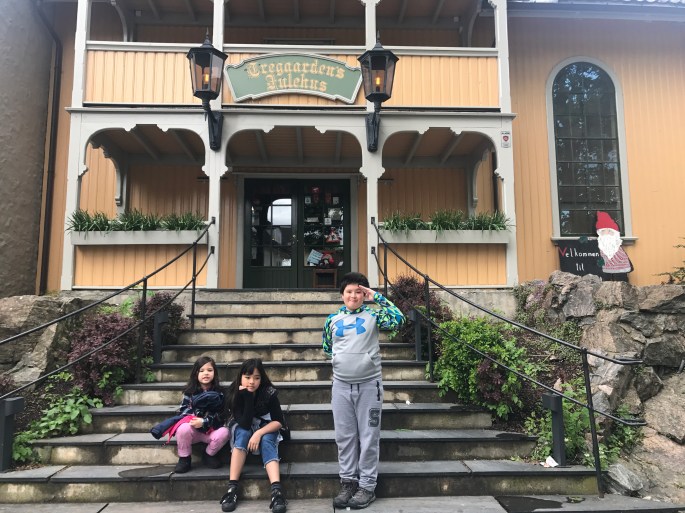
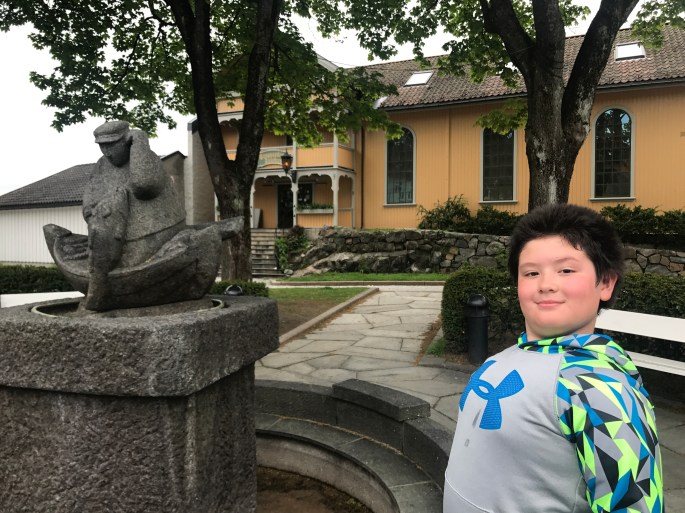
Behind the tiny park with the statue of a fisherman catching a famous Drøbak cod is Tregaardens Julehus which was originally a chapel and now the House of Christmas where the festive season of Christmas can be experienced all year round.
The market is the centre point of Drøbak which was renewed by world renowned architects, Snøhetta, way back in 1977. Life in the market square seems to be very active despite being in the spring season when we visited. There are cafes in the center wherein beautiful classic Norwegian houses can be seen. Along Storgaten, we noticed a merchant’s house from 1800, which was a secondary school for many years and prior to that, a hotel. It has been in the possession of ship owners, timber merchants and exporters of ice as well as the Consul for The Netherlands, Henry Parr Samuelsen.


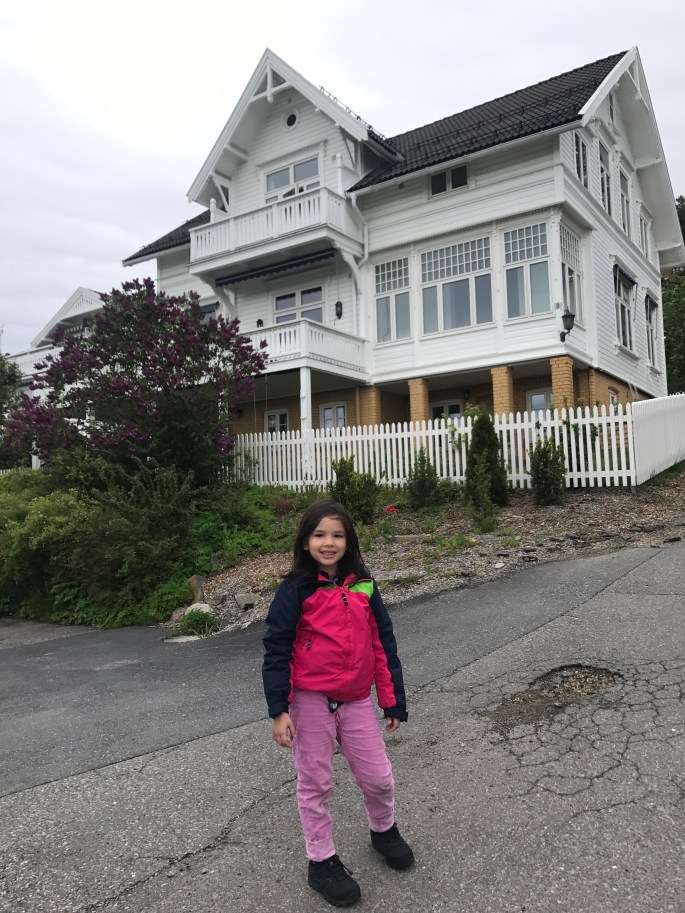
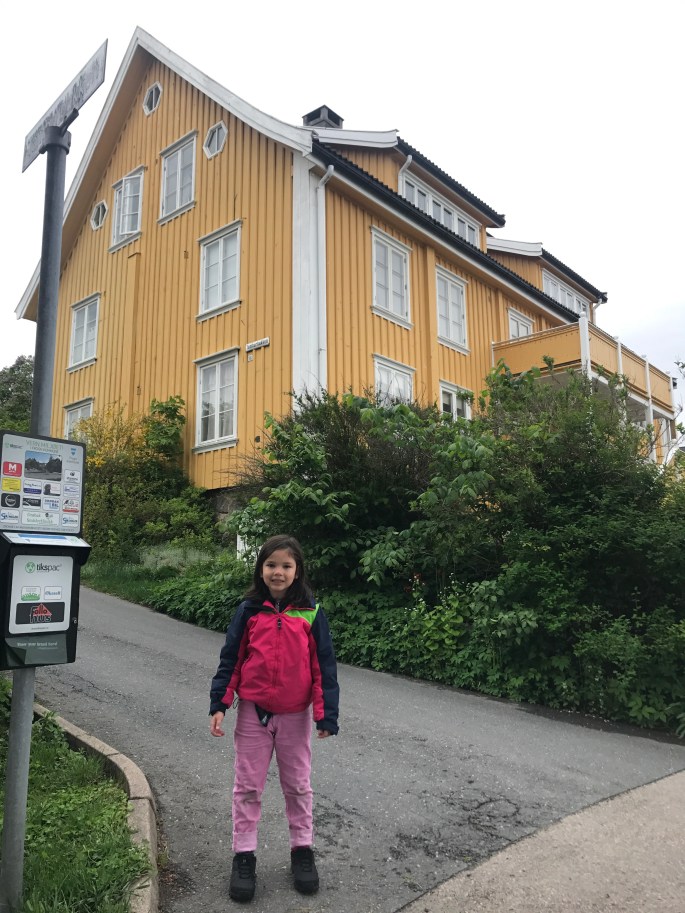
The large timber merchant houses are good illustrations of how Drøbak was built; a centrally placed main house surrounded by smaller buildingsfor the labourers, the sawmill staff and sea-farers. We know that in 1800, these properties were comprised of several buildings. In addition to the main house, there was an outhouse for the stable boys and there were stalls, pigsties and boatsheds, in all, some 12 buildings. Bankløkka, the large open area towards the church, was pasture and gardens belonging to the property. According to the people of Drøbak, Christian Magnus Falsen drafted the Norwegian Constitution in this house.
Kirkegatan (Church Street) with its avenue of trees which, when they were cut down provoked public outcry but fortunately they were re-planted again in 2013. The avenue leads to the town’s church, built in 1776. The writing above the door informs us that the entire building was a gift from Niels Carlsen, a merchant and a shipowner, and his wife, Martha Zacharuasdatter. This is one of the only churches in Norway donated to a community by a husband and wife. The interior is very interesting. The altar board has the same motive as the altar board in Our Saviour’s Church in Oslo. A curiosity worth noting is that the church clock has only one hand.

A bust of Niels Carlsen is situated close by, in the garden, by the path. Niels Carlsen (1734- 1809) was a rich businessmen and one of the country’s most powerful shipowners at the end of 17001s. He owned a large part of the property along the seafront as well as the small islands where Oscarsborg fort is now situated. He was the district’s most powerful and important citizen and benefactor, and demonstrated this by, among other things, his donation of the church.
The inscriptions over both the main door and the entrance to the north door tell us much about the spirit of times. The Carlsen family grave is a plot raised above the other graves in the churchyard.
By the church an entrance to Badeparken (Bathing Park), an area of smooth rock, paths and beaches for swimming and walking.In the park, we can see the old bath house from the time when there was a very active spa situated in the park. It was then possible to have a Roman bath or a mud bath or other facial treatments. Here, as in other places along the coasts, efforts were made to attract visitors and develop tourism at the time when sailing ships had to give way to steam-driven vessels and the timber trade and export of ice were no longer the same importance.
Some small distance to the east of the church is a characteristic square, wooden building that was also a donation to the community from the Carlsen family. It is called Drøbak Hospital, and a board over the main entrance (facing east) tells us of the donor’s intention for the house, for the benefit of impoverished widows.) This became the town’s first Old Peoples’ Home, but today, it is used by the church and for Senior Citizen activities such as canteen, a hairdresser, a chiropodist and numerous hobby activities and contact personnel for senior citizens.
In the middle of the park is the statue of Colonel Birger Eriksen. It was he who gave the order to open fire on the German cruiser, “Blucher,” on 9th April 1940. The statue of the Colonel shows him gazing out across the fjordto his fortress form where the cruiser sunk. This action helped to delay the German occupation of Norway by one whole day, making it possible for members of the government and the king himself to escape Oslo and avoid being taken prisoner by the Germans.
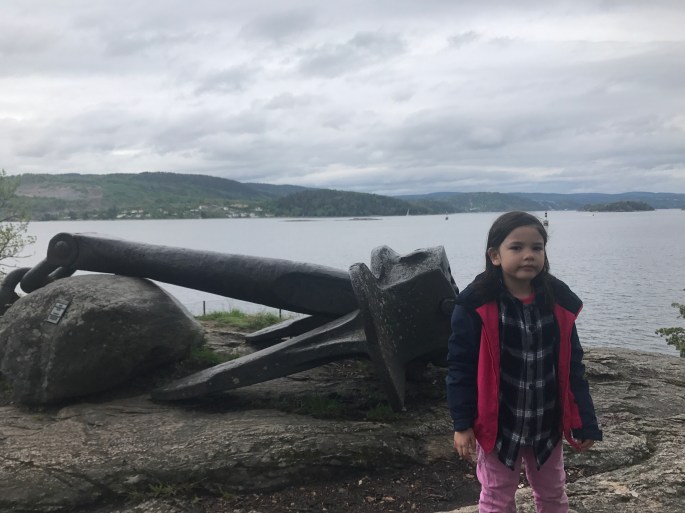


As we step out onto the breakwater with the view, we passed a bronze statue of three very attractive mermaids, a work by a local painter and sculptor Reidar Finsrud. Returning from our walk from the mermaids scuptures, we keep being amused by the gorgeous collection of small houses surrounding the small strip of coasts that many years ago was used for fishing boats (1750 – 1850)!

Would you like to explore Drøbak like we did? The Pearl By The Oslo Fjord… a stone’s throw way from Oslo. Well, figuratively of course.
 Turknoy Travels 100!
One thought on “Drøbak, A Pearl By The Oslo Fjord”